
Some links in this article may earn ToursZoom a commission at no extra cost to you — see our affiliate disclosure.
Last updated: April 2026
Rhine River cruises travel through five countries — the Netherlands, Germany, France, Switzerland, and sometimes Belgium — stopping at medieval towns, vineyard-draped hillsides, and UNESCO-listed gorges dotted with castles that have stood for eight centuries. Most itineraries run seven to eight days between Amsterdam and Basel, covering roughly 800 kilometers of the continent’s most storied waterway.
- Why the Rhine
- The Classic Route: Amsterdam to Basel
- Key Ports and What to Do There
- The Middle Rhine Gorge: Heart of the Journey
- Riesling Country and Rhine Wine Culture
- Practical Information
- Frequently Asked Questions
Why the Rhine
The Rhine is one of the few rivers in Europe where the scenery changes so dramatically from one day to the next that it never feels repetitive. In the Netherlands, the landscape is wide and flat, with windmills and cycling paths running along the dykes. Cross into Germany and the river narrows, the banks steepen, and suddenly you are threading through gorges with castle ruins perched on every ridge. Push south into Alsace and the architecture shifts — French half-timbered facades replace German baroque — while the wine style shifts from Riesling to Pinot Gris and Gewurztraminer. By the time you arrive in Basel, Switzerland is visible in the surrounding hills.
For travelers who want cultural variety without flight connections or packing and unpacking, it is hard to beat. The river does the moving; you wake up somewhere new each morning with the town already visible from your cabin window.
The Classic Route: Amsterdam to Basel
The standard Rhine River cruise runs between Amsterdam and Basel, though the direction varies by operator and departure. Some sailings go north to south, others south to north. Either works well — the scenery is the same, the experience differs mainly in how the light falls on the gorge.
A typical seven-day itinerary covers these stops:
- Amsterdam (embarkation, or Kinderdijk day trip)
- Cologne
- Koblenz
- Rüdesheim and the Rheingau wine region
- Strasbourg
- Breisach (gateway to the Black Forest and Colmar)
- Basel (disembarkation)
Some itineraries add a stop at Mainz, Speyer, or Heidelberg on extended sailings of eight to ten days. A few operators also offer Moselle extensions, pairing the Rhine with its most famous tributary.
Key Ports and What to Do There
Amsterdam
Most cruises embark or disembark in Amsterdam, which gives you good reason to arrive a day or two early or stay on afterward. The city itself warrants time, but the main Rhine-specific excursion from Amsterdam is Kinderdijk — a UNESCO World Heritage Site about an hour from the city where 19 windmills built in the 1740s stand in a preserved polder landscape. It is exactly what people imagine when they picture the Netherlands, and it remains genuinely impressive in person.
Cologne
Cologne is the largest city on the standard Rhine cruise route, and the approach by river is memorable: the twin spires of Cologne Cathedral rise above the skyline from several kilometers away. The cathedral itself took over 600 years to complete and is the largest Gothic cathedral in northern Europe. Allow at least two hours inside and climbing the south tower (533 steps) is worthwhile for the view over the Rhine bend. The old town sits just behind the waterfront, with the Roman-Germanic Museum and the Museum Ludwig (modern art) within easy walking distance. Cologne’s brauhaus culture is an experience of its own — the local Kölsch beer is served in small 200ml glasses that are continuously replaced until you put a coaster on top to signal you are done.
Koblenz
Koblenz sits at the Deutsches Eck — the German Corner — where the Moselle River flows into the Rhine. The confluence is marked by an enormous equestrian statue of Kaiser Wilhelm I and creates a dramatic triangular point of land you can walk out to. High above on the opposite bank sits Ehrenbreitstein Fortress, one of the largest preserved fortresses in Europe. A gondola cable car connects the town to the fortress, and the views from the top — over both rivers and the town below — are among the best on the entire route.
Rüdesheim
Rüdesheim is the quintessential Rhine wine town, small enough to walk end-to-end in twenty minutes and densely packed with half-timbered buildings, wine taverns, and the famous Drosselgasse: a narrow pedestrian lane lined with shops and bars that gets lively in the evenings. Above the town, the Niederwald Monument — a large Germania statue — looks out over the vineyards toward the river. The Rheingau region around Rüdesheim produces some of Germany’s finest Riesling, and local wineries offer tastings year-round. Siegfried’s Mechanical Music Cabinet museum is a quirky but worthwhile detour if you have time.
Strasbourg
Strasbourg straddles the French-German cultural line in a way no other city does. The Grande Ile, the historic island at the city’s center, is a UNESCO World Heritage Site in its own right. The Cathedral of Notre-Dame de Strasbourg — built between 1190 and 1439 — features an astronomical clock that still performs a mechanical show at 12:30pm each day. The Petite France neighborhood, with its canal channels, weir bridges, and 16th-century tanner’s houses, is one of the most photographed streetscapes in Europe. Alsatian food (tarte flambée, choucroute garnie, baeckeoffe) and the region’s white wines make Strasbourg a place where lingering over lunch is a reasonable decision.
Breisach and the Black Forest
Breisach is a small town on the German side of the Rhine used primarily as a gateway. Excursions typically go to one of two places: the Black Forest (for the landscape, cuckoo clocks, and cherry cake), or Colmar, a beautifully preserved Alsatian town in France just 30 kilometers away. Colmar’s Petite Venise quarter, with its flower-lined canals and Renaissance architecture, rivals Strasbourg for prettiness and draws far smaller crowds.
Basel
Basel is Switzerland’s cultural capital and a fitting end point. The old town — Altstadt — sits on a hill above the river with a fine cathedral, excellent art museums (the Fondation Beyeler is one of Europe’s best), and a compact medieval core. Excursions sometimes run to Lucerne or into the Bernese Oberland for mountain views, though these are long days. Basel itself rewards a slower approach.
The Middle Rhine Gorge: Heart of the Journey
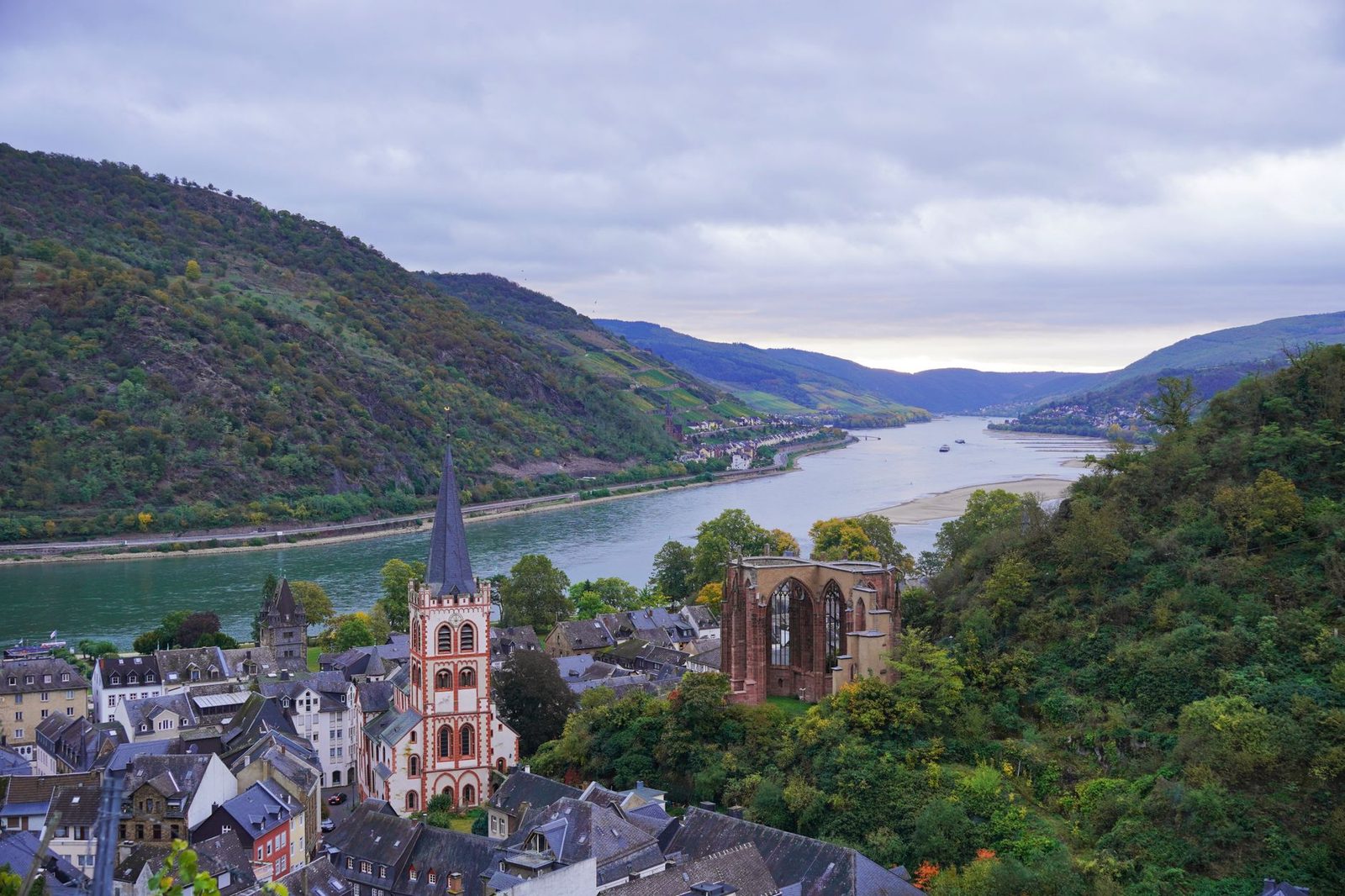
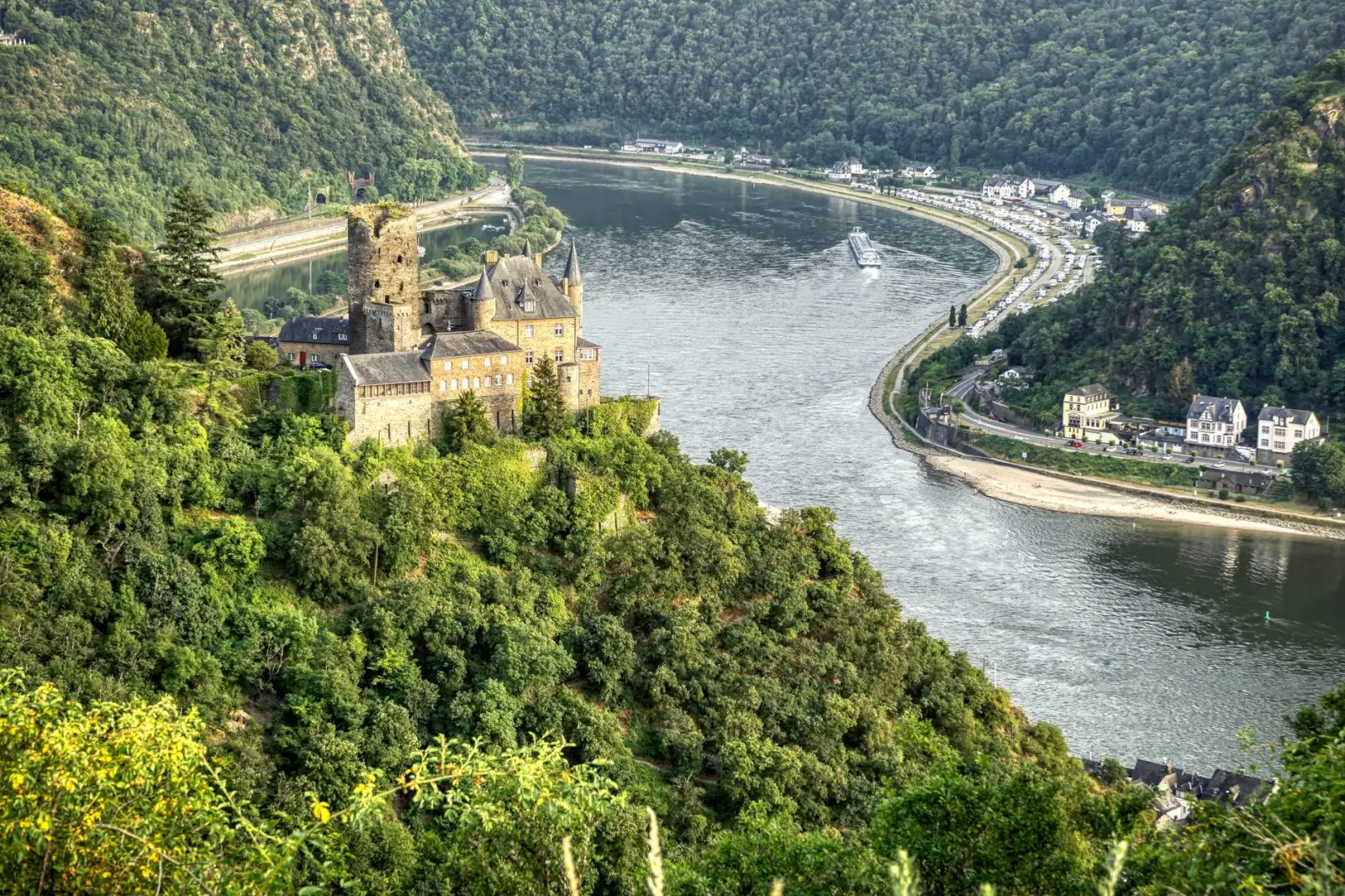
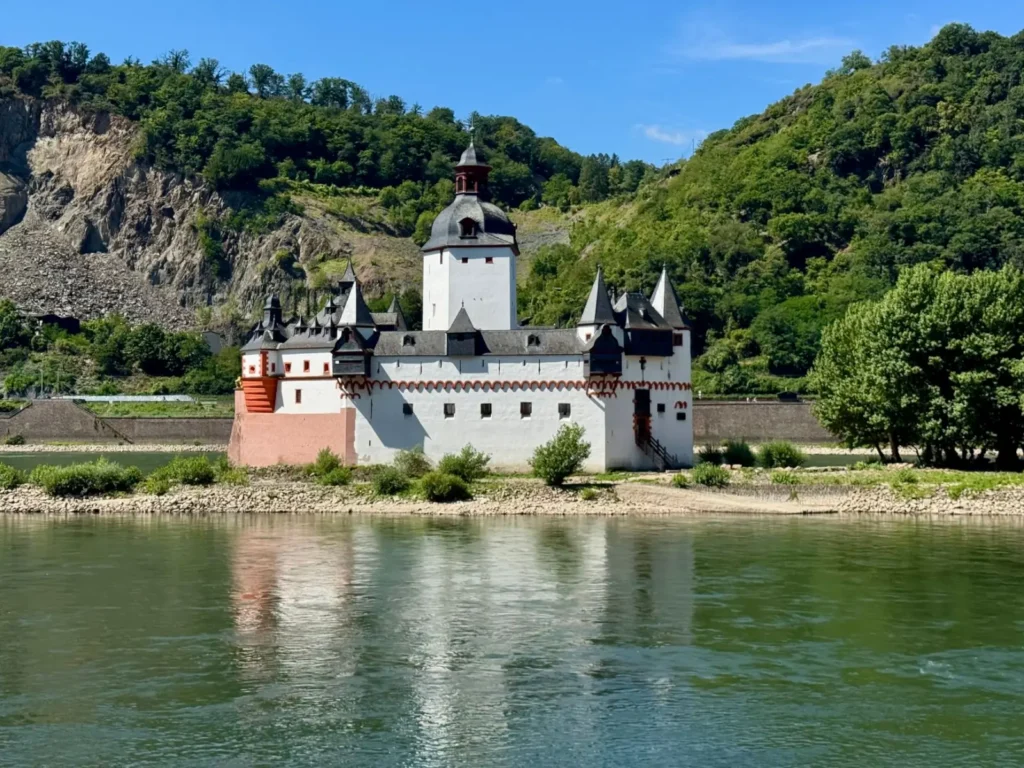
The 65-kilometer stretch between Rüdesheim and Koblenz — the Middle Rhine Gorge — is a UNESCO World Heritage Site and the visual centerpiece of any Rhine cruise. The river narrows, the valley walls steepen to near-vertical, and more than 40 castle ruins and fortresses appear on the ridgelines, some maintained, most in romantic decay.
The narrowest point of the gorge is at the Lorelei Rock: a 132-meter-high slate cliff near the town of St. Goarshausen where the river bends sharply and the current runs fast. German legend holds that a siren sat atop the rock luring sailors to their deaths. The cliff itself is impressive enough to justify the story. Ships slow through this section, and it is one of the most photographed moments of any Rhine cruise.
Notable castles in the gorge section include Marksburg (the only medieval Rhine castle never destroyed, intact since the 13th century, accessible on guided tours from Braubach), Rheinfels (a massive ruin above St. Goar), and Gutenfels above Kaub. Ships typically pass the gorge during the day when itineraries are timed right — worth checking before you book if this stretch is a priority.
Riesling Country and Rhine Wine Culture
The Rhine Valley is fundamentally a wine landscape. Vineyards run along the riverbanks for much of the German section, and the slate and quartzite soils — combined with the river’s heat-reflecting surface — produce conditions uniquely suited to Riesling. The grape thrives on steep slopes that would be impractical for any other agricultural use.
The Rheingau, concentrated around Rüdesheim and Eltville, is historically the most prestigious section. The Nahe and Mosel valleys, reachable as excursions from certain ports, add variety. If you are interested in wine, look for itineraries that include winery visits or wine-pairing dinners — many operators include these in the base price. Even if wine is not your focus, tasting a glass of estate Riesling at a tavern in Rüdesheim is simply part of being there.
Alsace, on the French section of the cruise, adds its own tradition: Gewurztraminer, Pinot Gris, and Muscat made in a distinctly fuller style than their German counterparts. The Alsatian wine route (Route des Vins) runs parallel to the river and is accessible from Strasbourg or Colmar.
Practical Information
Cruise Length
Most Rhine cruises run seven to eight days. Extended itineraries of ten to twelve days add ports on the Moselle, Main, or further upstream into Switzerland. Short cruises of four to five days are also available, typically covering the Amsterdam to Cologne or Cologne to Basel section only.
Ship Size
Rhine river ships are purpose-built for the river’s locks and low bridges. They carry between 100 and 200 passengers — substantially smaller than ocean ships — which makes for a more relaxed pace and easier shore access. Every cabin typically has a window or balcony.
What is Included
Most river cruise fares include cabin, meals, some excursions, and house drinks with meals. Premium operators tend to include most or all excursions and unlimited beverages. Read inclusions carefully when comparing prices, as what looks like a cheaper fare often has significant add-on costs.
Currency
Germany, France, and the Netherlands use the euro. Switzerland uses the Swiss franc. Most operators handle onboard spending in euros, but carrying some francs for independent time in Basel is useful.
Getting There
Amsterdam Schiphol and Basel-Mulhouse airports are the most common arrival and departure points for classic Amsterdam-to-Basel itineraries. Both airports have good transatlantic connections. Cologne/Bonn airport serves those joining at Cologne. Train connections throughout the region are excellent if you want to arrive or depart by rail.
Frequently Asked Questions
How long is a typical Rhine River cruise?
Most Rhine cruises run seven to eight days, covering the full route between Amsterdam and Basel or the reverse. Shorter sailings of four to five days are available for those with limited time, typically focusing on the most scenic central sections. Extended itineraries add the Moselle or Main rivers for ten to twelve days total.
What countries does a Rhine River cruise pass through?
A classic Amsterdam-to-Basel Rhine cruise passes through the Netherlands, Germany, France (Alsace), and Switzerland. Some itineraries include a brief stop in Belgium near Bruges. The cultural and linguistic shifts between countries are part of what makes the route interesting — you experience genuinely different food, architecture, and wine traditions within a single trip.
Is the Rhine River cruise scenic all the way through?
The scenery varies considerably along the route. The Dutch section is flat and wide, with windmills and agricultural land. The scenery peaks in the Middle Rhine Gorge between Rüdesheim and Koblenz — a UNESCO World Heritage Site with steep valley walls, castle ruins, and dramatic river bends. The French and Swiss sections are gentler but historically rich. Most travelers find the variety is a plus rather than a problem.
Do you need a visa for a Rhine River cruise?
Most of the Rhine cruise route runs through Schengen Area countries (Germany, Netherlands, France). Switzerland is not in the EU but is part of Schengen. Citizens of the US, UK, Canada, Australia, and most Western countries do not need advance visas for short stays. Check your specific passport requirements before traveling, as rules can change.
Can you do a Rhine River cruise independently rather than with an organized operator?
Yes. The KD (Köln-Düsseldorfer) line runs scheduled day-boat services along sections of the Rhine, including the scenic gorge section, and point-to-point tickets are available. This is a very different experience from an all-inclusive river cruise — you travel between ports independently and arrange your own accommodation on shore — but it is a legitimate way to see the river at lower cost and on your own schedule.